Small and mid-sized companies
Cut admin drag, sales follow-up delays, reporting friction, support repetition, and document-heavy work without hiring a large transformation team.
AI workflow orchestration for practical operators
AI Workflow Advisory helps founders, executives, professional teams, and independent experts turn repetitive work into clear, measurable AI-enabled workflows.
Start with a useful diagnostic
Use the AI Workflow Readiness Scorecard to identify whether your business needs workflow clarity, opportunity prioritization, or implementation support.
Authority that leads to action
These articles turn market examples, infographics, and research into practical operating lessons: controlled AI workflows, useful AI teammates, and successful deployment of AI orchestration.
 Featured executive strategy
The enterprise AI control plane is becoming the product
Featured executive strategy
The enterprise AI control plane is becoming the product
See why serious AI workflow value is shifting from isolated assistants to the layer that connects agents, data, applications, governance, and measurable work.
Read the source-backed article Advisory doctrine
Why useful AI workflows need a process harness
Advisory doctrine
Why useful AI workflows need a process harness
Build a governed AI layer around real work instead of giving agents permission to improvise inside the business.
 Small business AI
The SMB AI agent stack
Small business AI
The SMB AI agent stack
Support, sales, content, CRM updates, and customer knowledge are the best places to start.
 Operating model
From chatbot to operating loop
Operating model
From chatbot to operating loop
Turn AI from a chat window into a workflow with inputs, tools, review gates, and measurement.
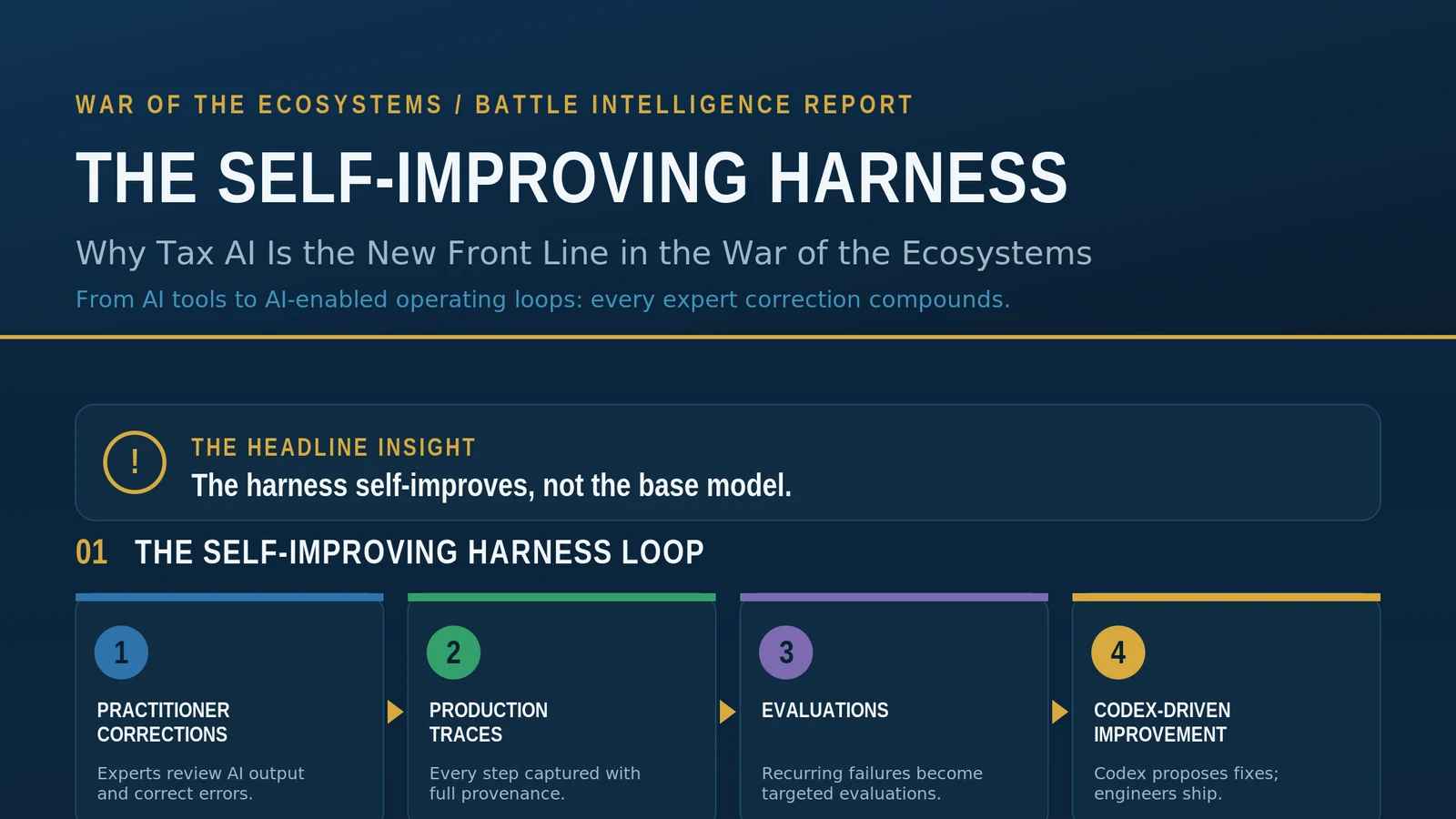 Successful deployment of AI orchestration
Tax AI workflow examples
Successful deployment of AI orchestration
Tax AI workflow examples
A practical deployment example for intake, review, research, reporting, response drafting, and knowledge reuse, supported by the self-improving workflow infographic.
Practical worksheet
Use the checklist to decide whether a workflow is repeated, painful, measurable, reviewable, and safe enough for a controlled first pilot.
Who this is for
Cut admin drag, sales follow-up delays, reporting friction, support repetition, and document-heavy work without hiring a large transformation team.
Identify where AI can create operating leverage now, which workflows deserve investment, and which shiny ideas should wait.
Improve research, proposal writing, client reporting, knowledge reuse, and delivery consistency while keeping expert judgment in control.
Build a personal operating system for content, clients, email, research, documents, and follow-up so the business feels lighter to run.
Choose your path
Start from the situation closest to yours, then use the diagnosis to turn it into a focused pilot.
Start with support, sales, content, CRM cleanup, or customer knowledge.
Professional servicesStart with intake, research, drafts, reports, review packs, or knowledge reuse.
Executive teamStart with a control layer: agents, data, permissions, review, measurement, and risk.
Independent professionalStart with content, email, follow-up, research, document work, or client delivery.
The method
Most AI initiatives fail because they start with tools. This advisory starts with the operating reality: where work gets stuck, where judgment is required, where handoffs break, and where automation can create measurable leverage.
Map the workflows consuming time, money, attention, and client confidence.
Rank opportunities by savings, revenue impact, implementation effort, and risk.
Define prompts, agents, approvals, automations, handoffs, knowledge sources, and governance.
Ship simple workflow improvements first, then expand what works.
Where value appears first
Good AI orchestration does not need to start with a huge platform decision. It can begin with the repetitive work already visible inside sales, service, documents, research, reporting, and executive operations.
Turn scattered notes, emails, calls, and documents into faster follow-up, cleaner proposals, and consistent next steps.
Reduce repeated status updates, spreadsheet work, meeting summaries, and manual coordination.
Improve research, drafts, review cycles, delivery quality, and reusable knowledge without replacing expert judgment.
Bring email, tasks, meetings, decisions, research, content, and follow-up into a more manageable rhythm.
Use knowledge bases, response patterns, and escalation rules to reduce repetitive support work.
Make prior work easier to find, summarize, reuse, and convert into useful client or internal output.
Advisory offers
Entry point
A focused session to identify where AI can reduce cost, save time, or improve throughput in your work.
Paid audit
A practical map of the top workflows to redesign, including value, effort, risks, and recommended next steps.
Implementation
Design and implement a small number of high-value workflows with clear controls and measurable outcomes.
Ongoing
Monthly guidance for leaders who want AI embedded into the way the organization actually operates.
What changes
Teams ask ChatGPT random questions, copy answers manually, and keep the same broken process underneath.
Workflows have clear inputs, prompts, knowledge sources, approvals, automations, and performance measures.
AI creates more noise: more tools, more pilots, more confusion, more fear of mistakes.
AI reduces drag: fewer repetitive tasks, faster documents, better follow-up, cleaner decisions, and less operational clutter.
Price-sensitive path
The first useful result is not a software bill. It is a clear map of the workflows where AI can create practical leverage, ranked by value and effort.
Team and collaboration model
AI Workflow Advisory is designed as a scalable team-based practice. The work starts with strategy and workflow architecture, then expands through collaborators, specialists, implementation partners, and client-side teams as each engagement requires.
Leads the advisory doctrine, ecosystem strategy, workflow orchestration method, and executive engagement model.
Reserved for technical builders, automation specialists, platform experts, and integration partners who can turn the operating design into working pilots.
Reserved for experts in tax, finance, legal, healthcare, professional services, sales operations, and other workflows where AI orchestration can create measurable value.
Every deployment is designed to include the people who own the work: leaders, operators, reviewers, and subject-matter experts who keep judgment and accountability in the loop.
Why this platform
The practice is built on a simple belief: the advantage is not the AI tool itself, but the operating system around it. Real value comes from connecting platforms, partners, workflows, data, human judgment, and adoption into practical business leverage.
This is ecosystem orchestration in real life: a coordinated model for bringing strategy, implementation, domain expertise, and client-side ownership into one operating loop.
A strategy-led approach for organizations and professionals who want AI to simplify operations, not create another layer of complexity.
Common questions
No. We start by mapping the work, the bottlenecks, and the measurable value. Tools come after the workflow logic is clear.
No. The offer is designed for companies of different sizes and for individual professionals who want to simplify their own operations.
Time saved, faster cycle time, fewer manual steps, cleaner follow-up, better document quality, and more consistent service delivery.
Yes. The issue is usually not access to AI. The issue is turning AI use into repeatable workflows with clear prompts, data sources, approvals, and handoffs.
You receive a practical view of the highest-value workflows to improve. If there is a strong fit, the next step can be a paid opportunity map or a focused implementation sprint.
First step
Use this to start a serious conversation about where AI can reduce cost, simplify operations, or increase output in your business or professional work.