Important: these are workflow orchestration examples, not tax, legal, accounting, or regulatory advice. Tax professionals and qualified advisors remain responsible for technical interpretation, filing positions, advice, and final decisions.
Use this as a menu of successful AI orchestration deployment opportunities.
Each example shows how one high-friction process can be mapped, governed, connected to the right knowledge sources, piloted with human review, and measured for time saved, error reduction, response quality, or shorter cycle time.
Have a professional-service workflow that is too manual?
Use the examples as a menu. We will choose one intake, review, research, reporting, or response workflow and shape it into a controlled pilot.
The deployment problem
Many tax, finance, and professional service teams already know AI can help. The problem is that most usage stays informal: one person asks a model a question, another copies output into a document, someone else reviews manually, and the organization learns almost nothing from the correction.
The opportunity is to turn that informal activity into a controlled workflow where AI supports intake, research, document preparation, review checklists, exception handling, communication, and knowledge reuse while qualified experts stay in control.
What real examples from the web show
Tax work needs structured knowledge
A published Intuit/TurboTax research paper describes a tax knowledge graph used to represent complicated tax logic, reason about missing information, calculate outcomes, and explain results. The deployment lesson is clear: AI needs governed knowledge, not loose answers.
Document intake can become a workflow
Business Insider reported that Intuit's AI work includes document understanding, automated checklist support, expert matching, and tax-associate note summarization. That is workflow redesign: intake, triage, handoff, review, and service in one operating loop.
Enterprise AI is moving toward control planes
Google, IBM, ServiceNow, and UiPath all position serious AI adoption around connected agents, company data, workflows, people, tools, governance, and monitoring. The pattern is bigger than tax: the winning architecture is orchestration.
The human review point is a feature
The most credible examples do not remove experts from high-stakes work. They use AI to prepare, structure, summarize, route, and check work so professionals can spend more time on judgment, exceptions, communication, and final approval.
AI orchestration deployments that can be designed and piloted
Document intake and triage
Organize uploaded documents, detect missing items, summarize what was received, flag unclear documents, and prepare a clean request list for the professional or internal team.
Tax research support desk
Turn a technical question into a structured research brief with assumptions, source checklist, open issues, confidence level, and required expert review before any advice is issued.
Workpaper review assistant
Check whether workpapers are complete, consistent, and review-ready. Surface missing explanations, unusual changes, incomplete reconciliations, or items that need a senior reviewer.
Response drafting
Draft plain-English responses using approved templates, known facts, and review notes, with clear separation between draft language and final professional advice.
Audit inquiry response room
Structure incoming authority or auditor questions, map evidence, track deadlines, draft response packs, and maintain a controlled trail of assumptions, documents, and sign-offs.
Tax knowledge base and precedent reuse
Convert prior memos, explanations, checklists, and review comments into reusable knowledge so the team stops solving the same operational problem from zero.
Filing calendar and obligation control
Turn deadlines, responsibility owners, document requests, and status updates into an operating cadence with fewer manual reminders and fewer last-minute surprises.
Exception and risk signal dashboard
Highlight cases with missing data, inconsistent facts, unusual movement, late responses, or review bottlenecks so leaders can focus attention where risk and value are highest.
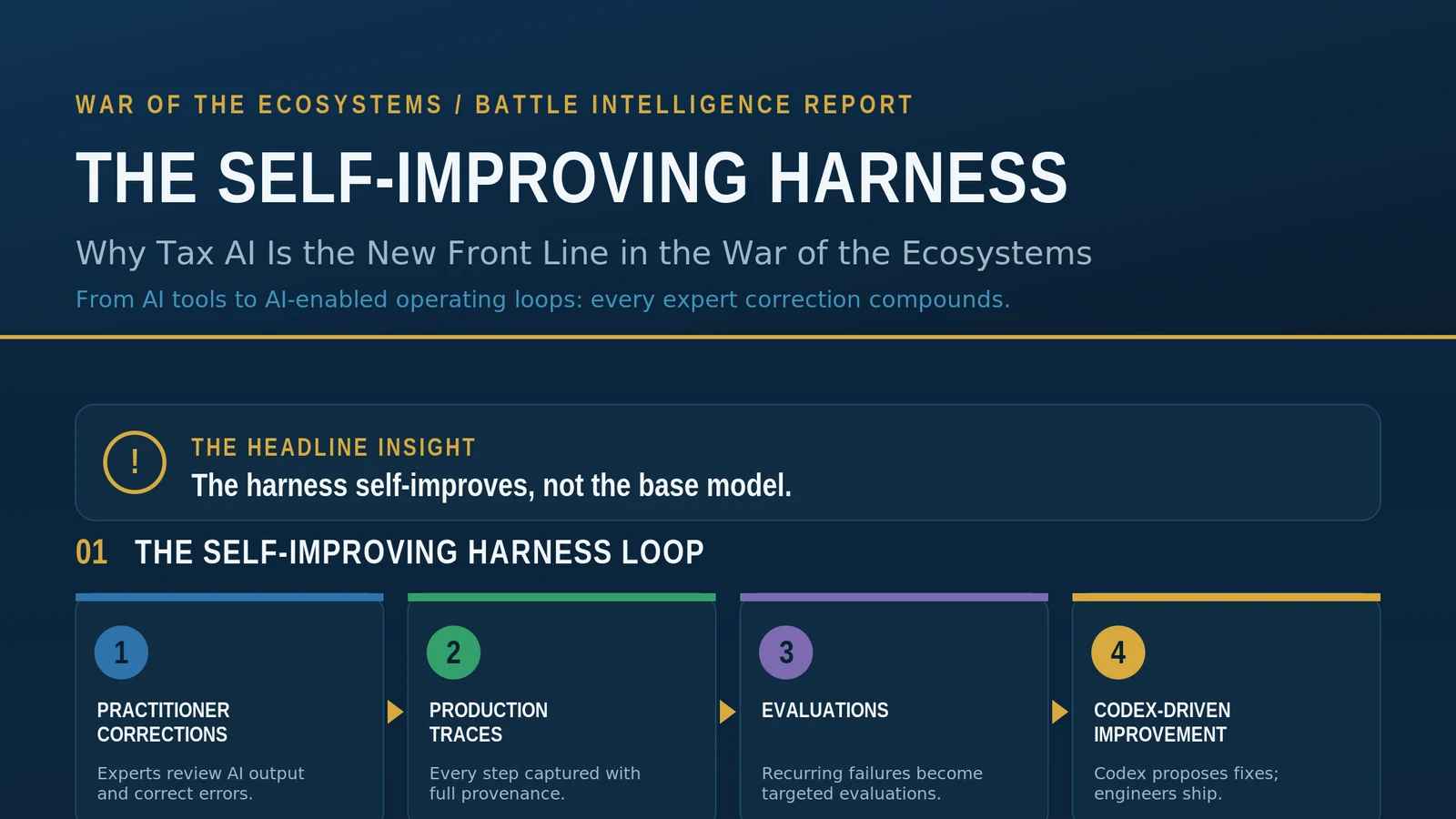
The self-improving harness
The strategic advantage is not that a model produces a first draft. The advantage is that the workflow learns from corrections. Every expert edit, rejected answer, missing-source flag, and review comment becomes a signal for better prompts, better checklists, better knowledge sources, and better evaluation tests.
- Practitioner corrections: experts review AI output and correct errors, omissions, tone, or structure.
- Production traces: the workflow captures what was asked, what source was used, what was changed, and why.
- Evaluations: recurring failures become test cases and quality checks.
- Workflow improvement: prompts, templates, routing, knowledge sources, and approval points improve over time.
How examples turn into implementation
Map the workflow
Document the current process, handoffs, bottlenecks, rework loops, data sources, quality controls, and moments where expert review is essential.
Prioritize the use cases
Rank opportunities by value, risk, implementation difficulty, data readiness, adoption effort, and whether success can be measured in a short pilot.
Design the AI operating model
Define prompts, templates, knowledge sources, human review gates, escalation rules, audit trail requirements, and success metrics.
Build the first pilot
Implement a practical workflow sprint with controlled inputs, review points, output templates, and a measurable before-and-after operating baseline.
Typical deployment deliverables
- Workflow map showing where AI can help and where human judgment must remain in control.
- Prioritized opportunity backlog with expected impact, complexity, risk, and first-pilot recommendation.
- Prototype workflow design covering prompts, templates, source material, review gates, exception handling, and measurement.
- Implementation sprint plan that a team can execute, improve, and scale after the first pilot proves value.
The goal is not to replace expert judgment. The goal is to protect it, scale it, and remove the repetitive work that prevents experts from spending time on the highest-value decisions.
Where to start
Start with one workflow where the pain is visible and the upside is measurable: document intake, review preparation, recurring technical questions, audit response, or professional communication. Then design the AI workflow around control, learning, and expert review.
Sources used for this perspective
- Tax Knowledge Graph for a Smarter and More Personalized TurboTax, arXiv.
- Business Insider reporting on Intuit and TurboTax AI workflow transformation.
- Google Cloud on Gemini Enterprise, showing agent orchestration, business data context, and governance.
- IBM watsonx Orchestrate, showing build, orchestration, governance, monitoring, and cross-system coordination.
- ServiceNow AI Agents, showing role definition, tools, knowledge bases, testing, monitoring, and iteration.
- UiPath Maestro, showing workflow orchestration across agents, robots, and people.